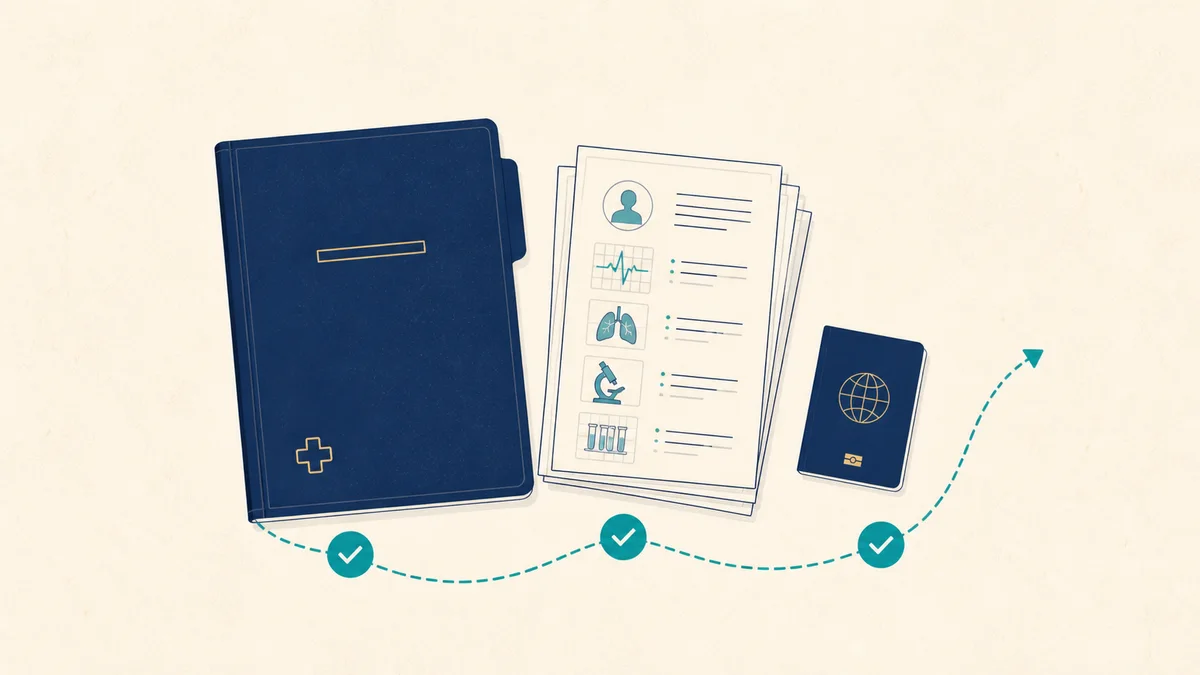
Direct answer. Before requesting treatment in China, prepare one structured medical file containing a current clinical summary, diagnosis evidence, imaging, pathology, laboratory trends, medication and allergy lists, prior treatment records, and your questions. Keep original files, add accurate English or Chinese translations when needed, and ask the receiving hospital which documents it requires before making travel decisions.
This guide supports preparation and communication. It does not diagnose a condition, recommend a treatment, or replace advice from your treating clinicians.
Key takeaways
- Start with a one-page clinical summary that explains the problem, current condition, major treatments, and reason for requesting a review.
- Preserve original imaging, pathology, and laboratory files; a screenshot or short report may not contain enough detail for specialist assessment.
- Record medicine names using generic names, doses, schedules, and the reason each medicine is taken.
- Translate for comprehension, but keep the original record beside every translation so clinicians can verify wording and numbers.
- Confirm the hospital, specialist, expected review process, follow-up plan, and travel fitness before booking.
Why record preparation affects the quality of a hospital review
An international consultation begins before a patient enters a clinic. A specialist can only interpret the history that reaches them. Missing dates, incomplete imaging, or an unclear medication list may force the clinical team to repeat tests, delay an opinion, or provide a conditional response. A well-organized file does not guarantee acceptance or a particular outcome. It gives the hospital a more complete basis for deciding whether it has the relevant expertise, what additional information is necessary, and whether an in-person visit is appropriate.
The CDC medical tourism guidance recommends discussing plans with a home clinician before travel, coordinating follow-up, and obtaining complete records to support continuity of care. The WHO patient safety calls to action also emphasize informed consent, access to records, questions, and participation in treatment decisions. These principles matter whether a patient is seeking oncology, cardiology, neurology, orthopaedic, rehabilitation, or another service.
The core medical records checklist
1. A one-page clinical summary
Place this first. Include full name, date of birth, main diagnosis or unresolved problem, relevant medical conditions, important procedures, current symptoms, functional limitations, and the reason for requesting a China hospital review. Add the names and contact details of the clinicians currently responsible for care. Write dates in an unambiguous format such as 15 August 2026.
The summary should distinguish confirmed facts from questions. For example, state that a pathology report identified a particular diagnosis only if that report is attached. If the diagnosis remains under investigation, say so. Avoid rewriting a complex history from memory when a clinician can help produce a reliable referral summary.
2. Diagnosis evidence and specialist notes
Include the reports that support the working diagnosis: consultation letters, discharge summaries, procedure notes, pathology reports, molecular or genetic reports when relevant, and formal staging or severity assessments. Arrange them chronologically and create a short index. If different clinicians reached different conclusions, include both rather than selecting only the preferred opinion.
3. Imaging in original digital format
Attach formal radiology reports and the underlying DICOM files for CT, MRI, PET, ultrasound, mammography, or other studies when available. A photograph of a scan displayed on a screen is usually not equivalent to the original study. Label each examination with date, body region, imaging type, and facility. If the file is large, ask the receiving team which secure transfer method it accepts instead of sending health data through an unapproved public link.
4. Pathology material
For cancer and other tissue-based diagnoses, include the pathology report and ask whether digital whole-slide images, unstained slides, stained slides, or tissue blocks may be required for review. Do not ship specimens before the hospital confirms its acceptance procedure, packaging rules, destination, and any customs or regulatory requirements. Keep a record of what was sent and retain material needed by the home care team.
5. Laboratory results as trends
A single result can be less informative than a sequence. Put relevant blood counts, chemistry, biomarkers, infection tests, or organ-function results into chronological order while preserving the original reports and reference ranges. Mark the date and whether the test occurred before, during, or after a treatment. Do not convert units unless the conversion is checked; copying the original unit prevents avoidable errors.
6. Medication, allergy, and device list
For every current medicine, record the generic name, brand name if useful, dose, route, frequency, start date, and purpose. Include non-prescription products, supplements, anticoagulants, insulin, pain medicines, and medicines taken only when needed. List allergies and describe the reaction rather than writing only “allergic.” Record implanted devices, prostheses, ports, pacemakers, or other equipment, including model information when known.
The CDC advises travelers with medical needs to plan adequate supplies and to carry clinician documentation for conditions and medicines. Review medication transport and entry rules with the relevant authorities and the treating team before departure; rules can change and some products require extra documentation.
7. Treatment history and response
Create a timeline of surgery, radiotherapy, systemic therapy, rehabilitation, devices, and other major interventions. For each, note the dates, regimen or procedure, response, important adverse effects, and reason for stopping or changing. Attach operative notes and discharge summaries. This helps a reviewing specialist understand what has already been tried and what constraints may shape later options.
8. Current clinical status
A historical file is not enough if the patient’s condition has changed. Include a recent clinician assessment, vital information relevant to the case, current mobility and daily-living ability, oxygen or nutritional support, infection status, and any urgent symptoms. Ask the home clinician whether the patient is fit to travel and what contingency plan is needed. Treatment abroad should not delay emergency or time-sensitive care at home.
Translation and file organization
Use a consistent folder structure: 01-summary, 02-specialist-notes, 03-imaging, 04-pathology, 05-laboratory, 06-medications, 07-treatment-history, and 08-administration. Give files meaningful names such as 2026-07-18_MRI-brain_report.pdf. Keep a read-only master copy and a separate working copy. Encrypt storage where practical and share records only through channels approved by the receiving organization.
A translation should remain traceable to its source. Put the original and translation together, keep numbers and units unchanged, and identify the translator or service. Automated translation can help navigation, but material decisions and consent require language support that the patient and clinical team can trust. WHO patient-safety material stresses that informed consent must be understandable and voluntary; a signature alone is not a substitute for comprehension.
Questions to send with the records
A hospital review is more useful when the request is specific. Ask whether the hospital treats the condition, which department and specialist would review it, what information is missing, whether remote review is possible, and what an in-person visit would aim to achieve. Ask for the expected sequence of appointments and tests, an itemized estimate where possible, likely length of stay, interpreter arrangements, and the plan for records and follow-up after returning home.
Use the hospital and doctor overview to understand how provider selection should be approached, then review the patient journey before discussing logistics. When the medical file is ready, the ChinaMedDirect concierge team can help route a structured request; the receiving hospital remains responsible for clinical acceptance and treatment decisions.
A final pre-submission check
Before sending, verify that the name and date of birth match across documents, every file opens, imaging is complete, translations are paired with originals, and the summary reflects the present condition. Remove duplicate files and unrelated personal information. Ask a clinician familiar with the case to check the summary for material omissions. Keep an export log showing what was shared, with whom, and when.
After any overseas care, request discharge information, procedure and medication records, imaging and pathology results, device details, and explicit follow-up instructions. Provide them promptly to the home team. The objective is a continuous clinical record, not two disconnected episodes of care.
Frequently asked questions
Do I need to translate every page before requesting a review?
Not always. Begin with the clinical summary and the reports most relevant to the decision, but ask the receiving hospital what languages and formats it accepts. Preserve the originals and use qualified language support for high-stakes material.
Are phone photos of scans sufficient?
They may help identify that an examination occurred, but they often lack the detail needed for formal interpretation. Request the radiology report and original DICOM files, then confirm the hospital’s transfer method.
Should I stop or change medicine before travel?
No medication change should be made from a general web guide. Discuss medicines, travel timing, and procedure preparation with the clinicians responsible for your care and the receiving hospital.
Does a complete file mean the hospital will accept the case?
No. Acceptance depends on clinical suitability, available expertise, capacity, risk, and the hospital’s own process. Complete records help the team make that assessment; they do not promise a result.